Tensegrity Metamaterials for Extreme Energy Absorption
Team Members
- Franco Ruffini
Funding
- Army Research Office (ARO), Mar 2024 – Aug 2027
Abstract
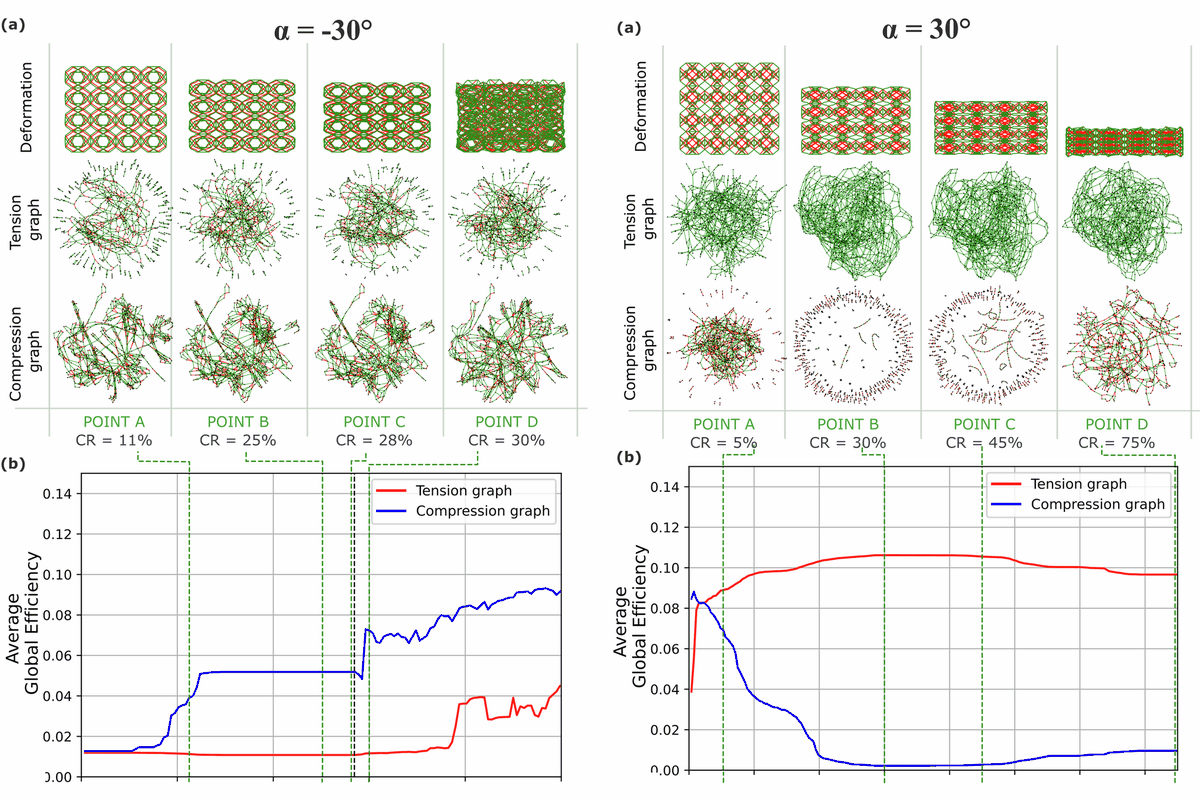
Tensegrity structures are assemblies of slender members in which pre-stressed tensile cables form a continuous network while compression bars remain isolated, so that each member keeps its sign of loading whatever the applied load. Built as periodic lattices, they become metamaterials with a property that no other known material system exhibits: instead of failing by localization, as a fracture surface, a shear band, or a collapsing layer of cells, they spread deformation through the whole volume, with a recoverable, foam-like stress plateau, and absorb orders of magnitude more energy than lattices of the same density. This project seeks the fundamental mechanisms behind that delocalization, with particular focus on the extreme nonlinear regime of severe deformations and deformation rates typical of blast exposure, and aims to distill them into design rules for metamaterials for extreme energy absorption. The working hypothesis is that delocalization is topological: it stems from the connectivity of the lattice rather than from its geometry. Our first results support it. Representing each lattice as a pair of graphs, the tension and compression networks, deformation delocalizes whenever the tension network remains more connected than the compression network, and graph-theoretic connectivity measures capture the transition quantitatively.
Related publications
- F. N. Ruffini and J. J. Rimoli, Asymmetric tension–compression connectivity governs deformation delocalization in truss-based metamaterials, npj Metamaterials (2026). Details
- J. de Castro Motta, K. Garanger, and J. J. Rimoli, Propagation of compression solitary waves on tensegrity-like lattices made of truncated octahedrons, International Journal of Non-Linear Mechanics (2024). Details
- J. Bauer, J. A. Kraus, C. Crook, J. J. Rimoli, and L. Valdevit, Tensegrity Metamaterials: Toward Failure-Resistant Engineering Systems through Delocalized Deformation, Advanced Materials (2021). Details
- J. J. Rimoli, A reduced-order model for the dynamic and post-buckling behavior of tensegrity structures, Mechanics of Materials (2018). Details
- J. J. Rimoli and R. K. Pal, Mechanical response of 3-dimensional tensegrity lattices, Composites Part B (2017). Details